It's over.
After 1B, I thought I had a pretty good idea of what a "busy term" looked like. I couldn't be more wrong.
This term felt different from 1B. 1B was chaotic because everything was new and the workload felt endless. 2A was still heavy, but in a more "you should probably actually understand engineering now" kind of way. The courses started feeling more specialized, more technical, and honestly, way more important.
Without further ado, here are my thoughts on ECE 2A.
ECE 250 - Algorithms and Data Structures - Dr. Ziqiang Patrick Huang
This was probably one of the most important courses of the term, especially if you’re interested in software.
ECE 250 covers the classic data structures and algorithms content: linked lists, trees, heaps, hashing, graphs, sorting, runtime analysis, and all the fun topics.
Overall, I thought this course was very standard. The content itself is useful, and it is one of those courses where you can really see how it applies outside of school.
An interesting part of this course were the projects. As AI is now more than good enough to completely do the projects, I was interested to see how the course would adapt. Dr. Mike Stachowsky, who previously taught our cohort ECE140 was in charge of the projects. He decided that the best way to handle this was to "analyze" your projects using AI. This would then give students feedback on their work and how they could improve.
It like sort of worked... I found it was decently helpful on the first project, but for the next 4 I received the exact same feedback word for word about adding cleaner comments. I believe this was probably due in part to the fact that the bulk of your code remains the same as you process the same data in basically every part of the project.
Quizzes were another interesting topic. 2 of our lab sessions were allocated towards in person quizzes, where you're given a list of inputs, outputs, and general rules/stdio commands that your program must respond to. Interestingly enough there were no test cases past very simple trivial cases, eg given ADD 2 should do something simple eg ADD 2. Your final submission is simply a tarball of your work which is submitted to a brightspace dropbox. This, according to the Prof caused a great deal of students to fail completely as their code failed to compile or output correctly. This was later remedied with adjusted grading but unfortunately the same issue occurred in the final quiz.
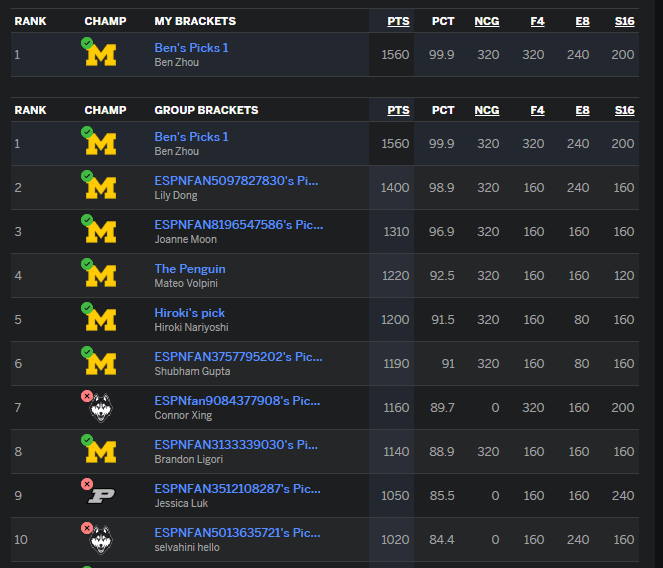
Patrick was great, he was very enthusiastic about the course and was a very engaging professor, he even held a fun little cohort competition for March Madness brackets and I ended up winning!
ECE 240 - Electronic Circuits 1 - Dr. Shiyu Su
The course of 2A, traditionally taught by Peter Levine, this course was notorious in previous years for having some of the most difficult exams in ECE. However, this year we had a new professor, Dr. Shiyu Su. I personally thought he was fine, although a lot of students had complaints about his teaching style being sometimes hard to follow and quite fast.
The exams ended up being quite difficult and ended up having a 40~ midterm average, the lowest our cohort has seen. However, Shiyu Su was very understanding, he ended up offering to redistribute some of the weights to allow for students to have a much better chance at passing the course (provided they do somewhat well on the final). Funny enough, this didn't seem to motivate many people and the final ended up also having a 40~ average.
This course covered things like diodes, transistors, amplifiers, filters (passive and active), and small-signal models. Essentially using everything you learned in ECE140 and applying it to more complex circuits with many more components.
I really don't have much else to say about this course, moreso that it had the same feeling as ECE140, you should stop expecting to get to a final answer all the time. It's much safer to ensure your process and work is correct and just pray you didn't make any major calculation errors.
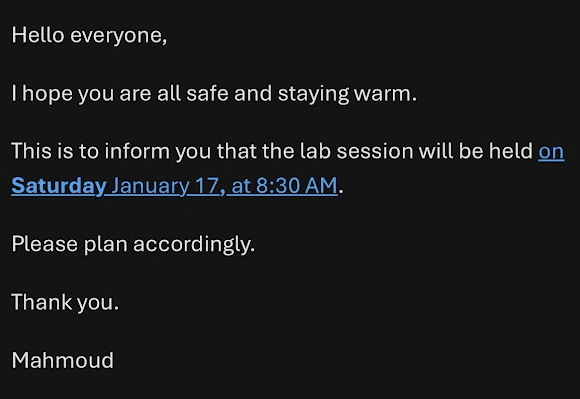
Labs were also interesting but ultimately not very engaging, I'm not sure how you could improve this experience but I felt it was just another time sink.
ECE 222 - Digital Computers - Dr. Hiren Patel
ECE 222! This was essentially our introduction to Assembly using Risc-V, as well as learning about datapaths and honestly just more lower level computer architecture concepts.
It was fun! I felt it was very intuitive and so even if I was maybe like 50% sure of my answer, I could just think about it logically and come to some sane conclusion that matched up most of the time.
The course was taught by Dr. Hiren Patel who has a reputation of being one of the best professors in ECE. I can tell why, his explanations were very clear and he was able to break down complex concepts well. He also was a very fair exam writer. He stressed a lot of points that I agreed with. One such case being memorization of specific instructions or opcodes is not important, but understanding how to use them and how to decode/encode them is much more important.
Labs were essentially just projects with short quizzes attatched. As seems to always be the case, they were in my opinion the most useless lab out of all the ones we had this term. I would not be suprised if more than 50% of the cohort just copied the labs from previous years or just used AI. None of the projects tested any sort of critical thinking or problem solving, nor did they touch on any complex concepts. There was a short quiz as well but you were given 8 possible questions in advance so again it was just memorization for a lot of students. All in all, it was mostly just reading from a datasheet and implementing around 100-200 lines per project with no real challenges.
ECE 204 - Numerical Methods - Dr. Douglas Wilhelm Harder
This course was basically about using computers to approximate math problems that are difficult or impossible to solve exactly. Topics included things like interpolation, root finding, numerical integration, differential equations, and error analysis.
It was certainly interesting at times, but overall not as engaging? I felt most of the methods we learned were shown as, the problem, the method, and a quick example, repeated maybe 100 times? Not to say that Harder was bad but I just didn't really enjoy the course...
Harder did introduce something interesting though, for this term students were actually encouraged to use AI to help with their assignments. Provided you provided the full prompt you used. I'm not really sure what the goal was here but I'll let you decide.
The midterm and final were average, nothing too special or amazing.
ECE 205 - Advanced Calculus 1 - Dr. Alison Cheeseman
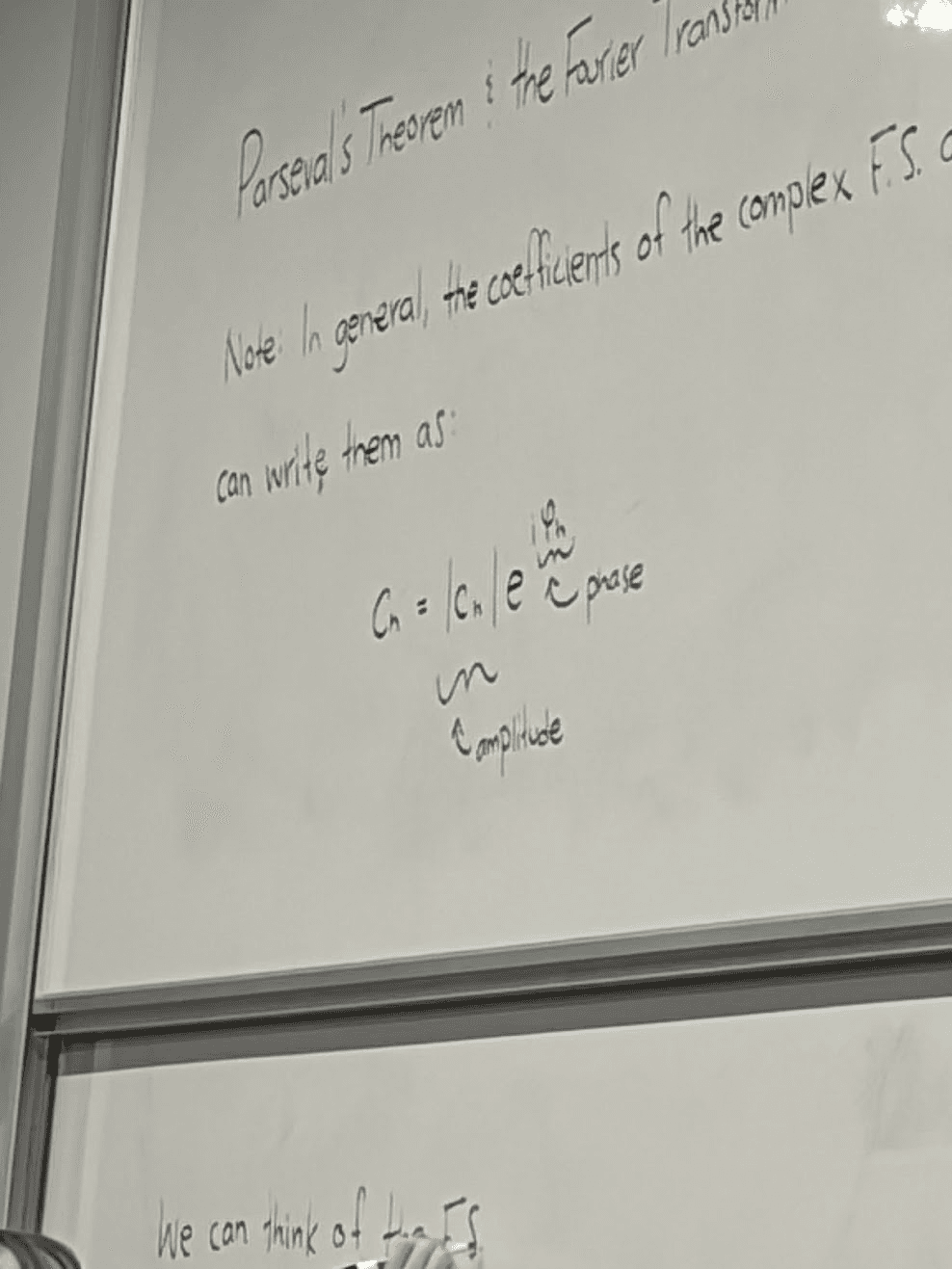
This course covered differential equations and laplace/fourier transforms. It was great! Thankfully this year the course was taught by some of the cleanest and most organized profs ever. If you ever have Dr. Cheeseman you'll be impressed by how clean her writing is! She was also very clear in her explanations and was able to answer questions very well. I have nothing else to add, everything here was perfect.
ECE 109 - Materials Chemistry for Engineers - Dr. Michal Bajcsy
ECE 109 was supposed to be the half-credit materials chemistry course. We were lied to, LOL.
There was no absolutely no chemistry. It was predominantly quantum mechanics and other random physics concepts that just seemed to be pulled from random parts within a provided textbook. For the first few weeks we learned about energy levels, wave functions, and the Schrodinger equation.
Dr. Bajcsy seemed pretty fair, but to be honest I don't think I have had a more disorganized professor. I don't doubt he has the credentials and knowledge to teach the course, but it just felt impossible to learn from him.
Lecture slides would be almost 70% formulas, with the text just being the names or short exerpts from the textbook. In the profs own words, we were never meant to understand any of the concepts fully. Instead we're expected to generally be able to formulate solutions and answers for explicit question types. For some lectures, I counted less than 9 people total in attendance which is pretty sad.
In addition this course had a must pass the final condition, stressing most students out as we were told around 30 students from the past cohort (total ~140) had failed, and after a curve still 11 students failed.
Funny enough, even though this was a half credit course, it had the most amount of work for homework and assignments. Never again! Some students even ended up dropping the course and filing grievances due to unrealistic expectations and workload.
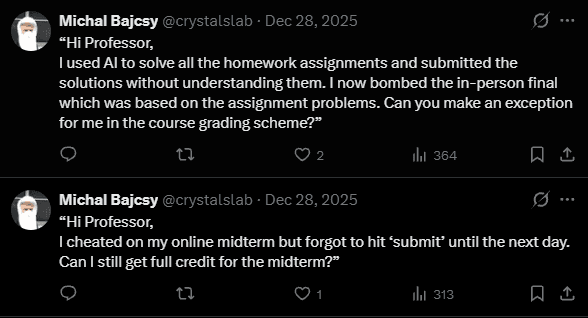
A student also found some posts from Prof Bajcsy on X.com where he seemed to be mocking the past cohorts students for getting near perfect scores on midterms yet somehow failing the final.
Co-op
This term was a lot lighter for me in terms of Co-op, I decided to take a return offer to go back to Grand Charter.
Super excited to be going back!
Final Thoughts
It's finally over, it honestly feels like every term keeps getting progressively more difficult, however thankfully, many previous classes have ranked 2A as the hardest term. I'm hoping this means 2B will not be as stressful, but I guess we'll just have to wait and see...
Thanks for reading!